Alternative Insight
Israel's Faltering Approach to Peace
The Zionist adventure defied historical challenge and attracted hundreds of thousands of Jews eager to start a Jewish homeland. Modern history has no example of peoples who came from various parts of the world without direction from a central authority or backing of a sovereign nation, spoke different languages, had tenuous cultural relationships and were able to enter a foreign land and succeed in establishing their own nation amidst alien peoples. The settling of America, South Africa and Rhodesia have similarities to the Zionist adventure--except each of their peoples were more closely related and eventually received support from former nations.
The Zionists had a mission to establish a Jewish homeland. They weren't entirely clear in the reasons for the mission. They spoke of continuous discrimination against Jewish people, who being a minority in all countries in which they lived and not sharing Christianity in a Christian western civilization, were subject to prejudices from which the Zionists believed they would never escape. They emphasized the plight of threatened and impoverished Russian Jews who lived in the Russian Pale that the Czar had inherited from Poland. And many spoke of finding means to halt the decline of Judaism and the Jewish heritage in a Europe that was emancipating its Jewish minority.
The Zionists ignored historical changes and often refused to adapt their strategy to the conditions of the times. They repeated the travails of Jewish communities--the separation of Jews from their surrounding neighbors. They pursued an awkward road to peace and stability for a Jewish nation. They started with a contradiction in their mission--their initial exclusion of Sephardic Jews.
An awkward start
Until 1949, one year after the establishment of the State of Israel, almost all Jewish immigrants to Palestine came from Europe. If Zionism had a mission to establish a Jewish homeland in Palestine for all Jews then a more acceptable strategy would have been to solicit the North African and Middle Eastern Jews to come to Palestine much earlier. The Middle Eastern Sephardic Jews would have blended well with the indigenous Palestinians. They had a common language and similar customs to the native peoples. This was especially true after World War I. The political aftermath of World War I diminished some of the reasons for the Zionist attention to the plight of European Jews. Instead of incorporating the "heartbeat " of history into their strategy, the Zionists started with an approach that initiated perpetual conflict.Post World War I
The political climate that emerged from the allied victories in World War I favored emancipation and democracy. The overthrow of the Czarist regime and installation of a communist government in the Soviet Union heralded the possibility that the Soviet minorities, including the Jews, would be treated equal to that of all Soviet citizens. The reasons for the Zionist adventure had been diminished--excepting their belief that emancipation would bring further integration of the Jews into other cultures and a decline in Jewish identification.The British mandate in Palestine, which prevented creation of an Arab state, gave the Zionists an opportunity to seize the moment and work towards creation of a Jewish state. The British Balfour Declaration and League of Nations had shown support for a Jewish homeland, which did not necessarily mean a unique Jewish state. At that time, the Zionists could have used the opportunity to solicit the North African and Middle East Jews (Sephardim) to establish that homeland. Instead only European Jews came, some of them to work in the British administration that they shared with Palestinian administrations. The recognizable identity of the European Jewish immigrants initiated an East-West conflict. If Sephardim had originally settled in the area, the conflict might have remained a dispute between Mid-East populations.
The Zionists aggressively pursued the growth of
Jewish populations and Jewish businesses and gave insufficient attention to their effects on the native population. Purchases of Arab land from local and Turkish landlords displaced Arab farmers whose families had tilled the same soil for generations. Factories and businesses, well financed by western Jews, and employing mainly Jewish laborers, brought bankruptcy to the lesser financed Arab businesses and severe unemployment to Arab laborers. Arabs reacted with strikes and attacks on Jews, but the Zionists ignored the import of the actions and increased their expanding efforts. Instead of making native populations less fearful and more secure, the intensity of the Zionist drive increased the fear and insecurity of the native populations. The attacks on Jewish populations should have awakened the Zionists to the effects of their encroachment on the local peoples and should have influenced their approach. Despite attempts at cooperation, by the late 1930's the two populations exhibited severe enmity and obvious conflict with one another. The events in Nazi Germany prompted the Zionists to assist in the re-location of the German Jews. Sadly, the increased immigrations fueled the conflict.
After WW II the uncertain status of Jewish refugees in a devastated Europe influenced world bodies to favor the immediate establishment of a Jewish state.
The UN Proclamation
In retrospect, the UN Proclamation 181, which partitioned Palestine and established the state of Israel, had fundamental flaws. The UN promoted the rapid expansion of persons into a land area that had limited resources to support a population expansion. Water scarcity in the desert atmosphere was a particular problem. By awarding the Zionists the Negev desert, the UN prepared the area for an irrigation that could eventually drain the area's water supply. The composition of the Jewish state-- 498,000 Jews and 325,000 Arabs--could not be acceptable to either population and predicted immediate problems. The UN had prepared the Middle East for struggle and catastrophe.The Zionists' ready acceptance of what, in effect, was a bi-national state that was anathema to them, indicated they must have had plans to modify the partition plan. In establishing their government on May 15, 1948, the Zionists did not include Palestinians in the new government. Within a year, Israel expanded its territory to contain its Jewish population in one contiguous area (see maps below). Its military actions stimulated the movement out of that entire area of about 700,000 Palestinians from a total Arab population of 900,000 (UN statistics). Israel never permitted the dispossessed Arabs to return to their ancestral homes. The Zionists took a path of defending by offending--making lifelong enemies to obtain security.
The maps below indicate the growth of Israel after the 1948-9 war. They show more. These maps, which have been prepared by an Israeli agency and appear in major encyclopedias, have Jaffa and Beersheba as part of Israeli territory.These designations are false. The partition Map of UN Resolution 181 incorporated Beersheba into the Grey colored area as part of an Arab state. Jaffa was incorporated as an Arab enclave and part of the Arab state. Note also that the post-partition map identifies the West bank as Samaria and Judea, both of which are Israeli designations for that region.
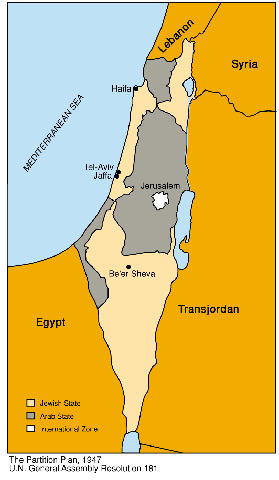
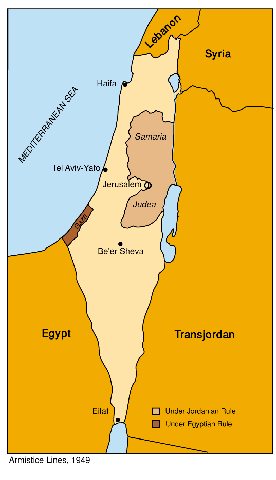
The Growth of Israel
During its growth, Israel committed errors similar to those of the Zionists--forge ahead, ask no questions, answer no questions, and don't completely digest the opinions of native populations and arguments of adjacent countries. The hostile attitude of Arab neighbors disturbed Israel. Israel's actions against Arab peoples and countries equally disturbed the Arab countries.The Palestinian refugees were not permitted to return. In 1956 Israel found reasons to invade Egypt and temporarily conquer the Sinai--without considering that the drastic action could precipitate decades of repercussions. The U.S. Eisenhower administration immediately forced the Israeli government to relinquish the conquered territory. Slowly a Palestinian retaliation against Israel's policies began to occur. Yasser Arafat organized a Palestinian Liberation Organization, that fought Israel with its only means--terror. Israel responded with military action. The Soviet Union, which had been the leading supporter of the UN proclamation that created Israel, became the leading supporter of the Arab nations, supplying mostly defensive arms that invigorated the military capabilities of those countries. A road to peace remained a road to war. Israel, in what it claims to be a defensive move, attacked Egypt and was then attacked by Egypt's allies--Jordan and Syria. Within 6 days, Israel captured the West Bank, Gaza, Sinai and all of Jerusalem. Its armies took the Golan after the U.S. had already organized a truce.
Post 1967
Other than China's incorporation of Tibet, Israel is the only country to conquer land and maintain it after the end of WWII. Although it had the power to impose a solution that allowed self-determination and still neutralize the areas it captured (it eventually relinquished control of the Sinai after having created several settlements and performed oil explorations), Israel continued with a military solution to control inhabitants of the captured territories.The occupation of the West Bank and Gaza exposed Israel's resolute determination to impose its will upon an area that didn't accept that will. During the 1970's, the Israeli government, under control of the Labor Party, started the settlements in the West Bank and Gaza that have expanded to 220,00 persons by the year 2000. The Labor and succeeding governments ignored UN Resolutions that demanded Israel not to modify the appearance of the captured territories and be prepared to vacate them. Despite propaganda and charges made by both sides to the conflict, the failure to abide by the UN resolutions and the continued expansion of settlements in the West Bank and Gaza remain the most significant reasons for the doom of the peace initiatives.
Present
Israel's policies did not accomplish its stated purposes, which were to create a security zone and combat terrorism. The failures are obvious.Israel has repeatedly blamed the present hostilities on Arafat and terrorism. Yet, the statistics tell a different story. The table below, which contains statistics compiled by B'Tselem, an Israel Human rights organization, shows that from the start of the Intifada II in September 29, 2000 until the beginning of the year 2001, 237 Palestinians were killed by Israeli forces in the occupied territories. More than 100 Palestinian civilians, of which about 1/2 were minors under 18 years of age, had already been killed before two terrorist bombings killed four civilians in Israel. No Israeli minors were killed in those terrorist bombings. The Israeli military launched heavy attacks against the Palestinians weeks before any terrorist campaign by Palestinian extremists.
WITHIN ISRAEL Month Palestinian civilians killed by Israeli security forces Of them: Minors under age 18 Palestinian civilians killed by Israeli civilians Israeli civilians killed by Palestinian civilians Of them: Minors under age 18 Israeli civilians killed by Palestinian civilians Of them: Minors under age 18 Sept. (from Sep. 29) 12 4 -- -- -- -- -- October 87 28 2 6 -- -- -- November 100 39 1 7 -- 4 -- December 38 10 3 5 -- -- -- Total 237 81 6 18 -- 4 -- The 54 years since the UN partition of Palestine have been marked by incessant terrorism by the Palestinians against the partition plan and Israel's policies. Spain and Great Britain, at times (and still somewhat today), suffered from terrorism at about the same level as Israel had until Sharon became Prime Minister. However Israel has taken different tactics against terrorism and these tactics have not resolved the problem. Israel's actions have been provocative. They have included mass expulsions of Palestinians, destruction of hundreds of Arab villages, usurpation of Arab lands for "military" purposes, construction of roads and settlements on Palestinian lands, destruction of Palestinian olive trees and water wells, economic deprivation, military actions that acquired Arab territory, increased human rights violations, planned assassinations of Palestinian leaders, and reprisals that at times have wantonly killed many innocent civilians and intended to strike fear in those who might contemplate challenges against Israeli authority. The assassinations of Palestine Authority police by Israeli forces signal that it is unlikely that Israel will permit the civil authority of a new Palestinian nation to have the the arms to protect its population--which makes doubtful a Palestine nation can be created.
The antagonisms that engaged the Arab and Zionist populations during the 1920's have grown into an intensive hatred that will remain for generations--the legacy of a faltering approach to achieve peace.
Future
Israel has indirectly stated to the world that its security depends upon control of the West Bank, Gaza and the Golan. It found itself on a road of conflict to achieve peace and is stuck on a road of eternal conflict--an endless road, whose border continually increases and widens the field of battle. The state of Israel is reaching its limits. Immigration cannot provide many more bodies, soldiers, pilots and tank commanders. Israel's strong but limited physical, material and military resources encounter slowly growing resources of an embittered Arab world. One day Israel might encounter a challenge that forces the use of non-conventional weaponry. The Mid-east conflict is unfolding with the threat of a nuclear war.alternativeinsight
march 16, 2002comments powered by DisqusHOME PAGE MAIN PAGE